
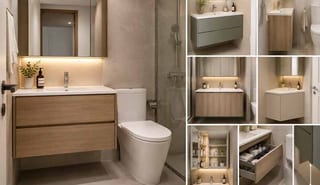
A bathroom vanity has to do more than look good. In a compact Singapore HDB or condo bathroom, it needs to provide useful storage, fit around the basin and plumbing, and leave enough space for comfortable movement.The right cabinet material matters too. Bathrooms are exposed to humidity, water splashes and regular cleaning, so the cabinet substrate, edge protection and finish should be selected with the environment in mind.
Drawing on La Maison Carpentry’s experience across 1,300+ completed projects, this guide covers practical bathroom vanity cabinet design ideas for Singapore homes, including compact layouts, suitable materials, sizing considerations, indicative 2026 costs, and important HDB renovation requirements.
Why Bathroom Vanity Design Matters in Singapore HDB Bathrooms
Space is usually the first challenge.A bathroom already needs to accommodate a toilet, basin, shower area, door clearance and walking space. Adding a vanity that is too deep or too wide can make the room feel crowded and make everyday tasks less comfortable.
A well-planned vanity can solve several problems at once:
- Create dedicated storage for toiletries, towels and cleaning products
- Keep the countertop less cluttered
- Make use of otherwise unused wall or floor space
- Integrate the basin and storage into one compact unit
- Improve the visual appearance of a small bathroom
- Make cleaning and everyday maintenance easier
The important point is that vanity size should not be chosen from bathroom floor area alone. Wall length, basin dimensions, plumbing position, door swing and required clearance all affect the final design.
For a compact HDB bathroom, a smaller cabinet that fits the room properly is often more practical than simply choosing the largest cabinet available.
5 Bathroom Vanity Cabinet Design Ideas for Small Singapore Bathrooms
There is no single layout that works for every HDB or condo bathroom. The best option depends on the available wall, plumbing, storage requirements and how much circulation space you need.
1. Floating or Wall-Mounted Vanity
A floating vanity is one of the most practical choices for a compact bathroom.Because the cabinet is mounted above the floor, more of the floor remains visible underneath. This can make a small room feel less visually crowded and also makes floor cleaning easier.
Best for:
- Small HDB bathrooms
- Minimalist interiors
- Bathrooms where easy floor cleaning matters
- Homes that want a lighter visual appearance
A compact floating vanity can also be paired with drawers rather than hinged doors to make everyday storage easier to access.
2. Slim-Depth Vanity
Width is not always the main problem.
Sometimes the bathroom has enough wall length but not enough front-to-back space. In that situation, reducing cabinet depth can preserve the walkway without sacrificing the entire vanity.
A slim-depth vanity can work particularly well when:
- The toilet is positioned close to the basin
- The bathroom entrance is narrow
- The shower area reduces circulation space
- You need storage without a bulky cabinet
Before fabrication, check the actual basin dimensions and plumbing connection. A cabinet that is too shallow may limit your basin and storage options.
3. Under-Counter Vanity
An under-counter vanity combines the basin area with storage below it.
This is useful when you need more enclosed storage for:
- Toiletries
- Towels
- Cleaning products
- Hair-care products
- Spare bathroom supplies
For a larger bathroom wall, the cabinet can be customised to provide additional countertop space.The key is to avoid filling the entire wall simply because the space is available. Storage should match what you actually use.
4. Corner Vanity
A corner vanity can make use of a space that would otherwise remain difficult to use.It can be suitable for unusually narrow or irregularly shaped bathrooms where placing a standard vanity along the main wall would interfere with movement.However, corner designs need careful measurement. The basin, cabinet doors, plumbing and nearby fixtures all need to work together.
5. Vanity with Mirror Cabinet Storage
If floor space is limited, look upward.Combining a vanity with a wall-mounted mirror cabinet can add storage without requiring a much larger floor cabinet.For example, frequently used toiletries can be stored behind the mirror, while larger or less frequently used items remain inside the lower cabinet.This creates a useful vertical storage system for compact bathrooms without adding another piece of furniture to the floor.
What Size Vanity Cabinet Fits a Singapore HDB Bathroom?
There is no universal vanity size that fits every HDB bathroom.A compact vanity may commonly fall around the 40cm to 60cm width range, while larger wall runs can accommodate wider custom cabinets. Current Singapore bathroom vanity products also show compact options starting around 40cm, while 60cm is a common ready-made size.
But width is only one measurement.Before choosing a vanity, consider:
- Available wall width
- Cabinet depth
- Basin size
- Toilet position
- Shower area
- Door swing
- Plumbing location
- Drawer or door opening
- Walking clearance
- Required storage
A simple way to plan the size
Small bathroom: Prioritise a compact or slim-depth vanity.
Medium bathroom: Consider a wider under-counter cabinet with additional storage.
Larger bathroom: A wider vanity with double-basin or additional countertop space may be possible if the plumbing and layout allow it.
The final measurement should always be based on the actual bathroom rather than a generic standard HDB bathroom size.
Best Materials for Bathroom Vanity Cabinets in Singapore
Material selection becomes particularly important in a bathroom because the cabinet is exposed to moisture, humidity and water splashes.There is no single material that is automatically best for every project. The right choice depends on the cabinet construction, finish, installation quality, budget and how exposed the cabinet will be to water.
Marine-Grade Plywood
Marine-grade plywood is commonly considered for moisture-prone cabinetry because of its construction and moisture-resistant adhesive system.
It can be a good option when you want a more conventional cabinetry appearance while improving resistance to humid conditions.
However, marine-grade plywood should not be treated as completely waterproof. Proper edge sealing, surface finishing, installation and protection from standing water still matter.
PVC
PVC cabinetry is popular for bathroom applications because the material is resistant to moisture and easy to maintain.It can be particularly useful in areas where regular water exposure is expected.When comparing PVC cabinets, do not look only at the word “PVC”. Check the actual construction, thickness, hardware, fittings, finish and installation method.
Aluminium
Aluminium is another option for wet-area cabinetry.It offers strong moisture resistance and can suit modern bathrooms where durability and easy maintenance are priorities.The trade-off is usually design preference and cost. Aluminium has a different appearance from conventional wood-based cabinetry and may cost more depending on the construction and finish.
Which Material Should You Choose?
A simple comparison looks like this:
| Material | Main advantage | Consider before choosing |
| Marine-grade plywood | Familiar cabinetry look and strong construction | Needs proper finishing and moisture protection |
| PVC | Moisture-resistant and easy to maintain | Check construction quality and hardware |
| Aluminium | Strong option for wet environments | Usually a more premium material choice |
The material alone does not determine durability. Cabinet construction, edge treatment, hardware, ventilation and installation all contribute to how well the vanity performs over time.
Bathroom Vanity Cost in Singapore 2026
The cost of a bathroom vanity depends on more than cabinet size.
Material, countertop, basin, hardware, storage configuration, finish, installation and the amount of customisation can all change the final price.
Current Singapore listings show a wide range. For example, ready-made or semi-custom vanity options can start from several hundred dollars, while custom bathroom vanity projects can reach S$2,000 or more depending on the specification.
For planning purposes, you can use the followingindicative budget ranges:
| Vanity level | Typical configuration | Indicative budget |
| Basic | Compact vanity with standard finish and simpler configuration | S500–S800 |
| Mid-range | Custom-sized cabinet with upgraded material, finish or storage | S850–S1,500 |
| Premium | Aluminium or higher-spec cabinetry, upgraded countertop, hardware and additional features | S1,600–S2,800+ |
These figures should be treated as planning ranges rather than fixed Singapore-wide prices. Actual quotations can vary significantly depending on the dimensions, materials, countertop, basin, hardware, installation requirements and whether other bathroom works are included.
What Can Increase the Cost?
The final price can increase when you add:
- Larger cabinet dimensions
- Premium cabinet materials
- Quartz or other upgraded countertops
- Custom basin configurations
- Soft-close hardware
- Additional drawers
- Mirror cabinets
- LED lighting
- Special finishes
- Complex plumbing adjustments
- Removal of an existing cabinet
- Additional installation work
If you are renovating several areas of your home, it is useful to budget the vanity as part of the wider renovation rather than looking at the cabinet price alone.
For a broader kitchen renovation budget, see our kitchen renovation cost guide.
HDB Bathroom Renovation Considerations
Installing a vanity cabinet is not necessarily the same as carrying out a full bathroom renovation.A simple cabinet replacement is different from work involving wall or floor finishes, plumbing changes, hacking or other regulated renovation activities.
HDB states that homeowners must engage contractors from its Directory of Renovation Contractors for renovation works, including works that do not require HDB approval. Certain works, such as demolition or hacking of walls, require prior written approval.
Before work begins, confirm which requirements apply to your exact scope.
Pay Attention to the 3-Year Bathroom Restriction
This is particularly important for newer HDB flats.HDB currently states that the wall and floor finishes provided in newly built flats’ toilets and bathrooms must not be removed for three years from the completion date of the block. The restriction is related to the waterproofing system beneath the bathroom finishes.
This means a vanity project that involves only cabinetry is different from a renovation that also requires removal of bathroom tiles or other wet-area finishes.If your project includes tile removal, hacking or other wet works, check the current HDB requirements before starting.
You can also read our HDB renovation approval guide for more renovation planning information.
What About Plumbing?
Be careful when a vanity installation involves moving pipes, changing drainage or altering existing sanitary connections.
The applicable requirements depend on the exact plumbing work being carried out. Do not assume that a cabinet replacement and a plumbing alteration are covered by the same rules.
A good renovation plan should identify:
- Existing water supply points
- Waste pipe location
- Basin position
- Access for maintenance
- Any required plumbing changes
Planning these details before fabrication can reduce the chance of costly modifications later.
HDB vs Condo Bathroom Vanity: What Changes?
The cabinet design itself may be similar, but renovation requirements can differ depending on the property.
HDB
HDB bathroom work needs to follow applicable HDB renovation requirements. This becomes particularly important when the project involves hacking, removal of bathroom finishes, plumbing changes or other regulated works.
Condo
For a condominium, the development’s management or MCST may have its own renovation requirements, working hours, access procedures and contractor rules.
Before installation, check with the condo management on matters such as:
- Renovation approval
- Working hours
- Lift protection
- Delivery access
- Disposal requirements
- Plumbing or wet-work restrictions
In both cases, the actual bathroom layout still matters most when designing the cabinet.
How to Choose the Right Bathroom Vanity Design
Instead of choosing a vanity based only on appearance, work through these questions first.
1. How much wall space do you have?
Measure the usable wall rather than the entire bathroom.
2. Where are the existing pipes?
Keeping the vanity close to existing plumbing can simplify installation and reduce unnecessary work.
3. How much storage do you actually need?
If you only store a few daily-use products, a large cabinet may waste valuable space.
4. Do you prefer drawers or doors?
Drawers provide easy access to smaller items, while doors can be useful for larger products and simpler cabinet configurations.
5. How much depth can the bathroom accommodate?
A shallow cabinet may be more useful than a wider but deeper one if the walkway is tight.
6. How exposed will the cabinet be to water?
A vanity directly beside the shower needs a different moisture strategy from one positioned in a relatively dry area.
7. What will happen around the vanity?
Check the relationship between the cabinet, basin, mirror, toilet, shower screen and bathroom entrance before finalising the design.This is where custom design becomes useful. The objective is not simply to make a cabinet fit the wall. It is to make the entire bathroom work together.
Common Bathroom Vanity Mistakes to Avoid
A few small planning mistakes can create daily frustrations.
Choosing the largest cabinet possible
More storage sounds useful, but an oversized cabinet can make movement difficult.
Ignoring cabinet depth
A vanity can fit the wall perfectly and still make the bathroom uncomfortable if it projects too far into the walkway.
Choosing material based only on appearance
A beautiful finish does not automatically make a cabinet suitable for a humid bathroom.
Forgetting plumbing access
Future maintenance can become difficult if the cabinet is designed without considering pipe access.
Adding too many storage features
Extra drawers, shelves and accessories can increase cost without improving the bathroom if they are not actually needed.
Installing before confirming measurements
Bathroom walls, plumbing points and fixtures should be measured carefully before custom fabrication begins.
Planning a Bathroom Vanity as Part of a Larger Renovation
A vanity upgrade is often only one part of a wider home renovation.
If you are also renovating your kitchen, cabinetry, countertops, plumbing, storage and installation need to be coordinated across the project.
La Maison Carpentry provides kitchen remodeling services for Singapore HDB flats, condominiums and landed homes, including custom cabinetry, storage, countertops, plumbing-related work and installation.
Planning the two areas together can also make it easier to coordinate material choices, project schedules and the overall design direction.
Bathroom Vanity Cabinet Questions Singapore Homeowners Ask
What size vanity fits an HDB bathroom?
There is no single size that fits every HDB bathroom. Compact vanities around 40cm to 60cm wide can work well in smaller spaces, but the final size should be based on the available wall width, basin, plumbing, door swing and required circulation space. Current Singapore products also offer vanity widths starting around 40cm.
Is PVC or plywood better for a Singapore bathroom?
Both can work, depending on the cabinet construction and where the vanity is installed. PVC offers good moisture resistance, while marine-grade plywood can provide a conventional cabinetry appearance with better moisture resistance than ordinary plywood. Neither should be treated as completely maintenance-free or waterproof under every condition.
Is aluminium good for bathroom vanity cabinets?
Aluminium can be a practical option for moisture-prone bathroom cabinetry because it is resistant to water exposure and easy to maintain. It can also suit modern bathroom designs. The main considerations are cost, appearance and the specific cabinet construction.
Do I need HDB approval to install a new bathroom vanity?
A straightforward cabinet replacement is different from renovation work involving hacking, tile removal, plumbing alterations or other regulated works. HDB requirements depend on the exact scope. Newly built HDB flats also have a three-year restriction on removing bathroom and toilet wall and floor finishes. Check the current HDB requirements before starting any work that goes beyond a simple cabinet replacement.
How much does a custom bathroom vanity cost in Singapore?
A bathroom vanity can range from several hundred dollars for simpler configurations to more than S$2,000 for larger or higher-spec custom projects. The final quotation depends on size, cabinet material, countertop, basin, hardware, finish, storage configuration and installation requirements. Current Singapore market examples show this broad variation.
Plan Your Bathroom Vanity Around Your Space
A good bathroom vanity is not simply a cabinet with a basin on top. For a Singapore HDB or condo bathroom, the design needs to balancestorage, dimensions, circulation, plumbing, moisture exposure and appearance.
Start with the actual bathroom measurements. Then choose the vanity layout, cabinet depth, material and storage configuration around those constraints.If you are planning a custom bathroom cabinet or a wider home renovation, speak with an experienced renovation team before fabrication begins. A proper site measurement and design discussion can help identify practical issues before they become installation problems.
Contact La Maison Carpentry for a renovation consultation to discuss your space, cabinetry requirements and renovation scope.