
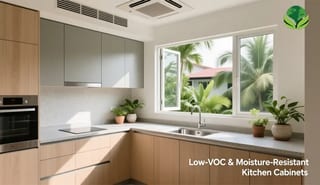
In Singapore’s humid climate, kitchen cabinet selection is not just about style or budget; it is directly related to durability and Indoor Air Quality (IAQ). Daily cooking, high temperatures and humidity (RH) of >80% pose a major challenge to common cabinet materials, such as standard particleboard or MDF. This condition can quickly lead to fungus growth, swelling and warping of the material. More importantly, there are health risks.
In this blog post, we will take an in-depth look at the cabinet materials and low-VOC and moisture resistant kitchen cabinets options for your humid climate kitchen cabinets, drawing on La Maison Carpentry’s 1,014 successful projects completed across Singapore. We will see how choosing the right materials can help you create a healthy, long-lasting and sustainable kitchen.
Why Humidity Matters in Singapore Kitchens
Singapore is a tropical country with an average relative humidity (RH) that often exceeds 80%. This high RH, combined with daily cooking, steaming and kitchen activities, creates an environment that is extremely hostile to common wood materials.
Moisture and damage to wood-based materials:
The main problem with common MDF (Medium Density Fiberboard) or particleboard, which are made at a low cost, is that these materials absorb water vapor like a sponge. As a result of moisture absorption:
- Swelling and Warping: Swelling and warping of cabinet doors and shelves, especially near the sink, can be seen.
- Mould Growth: Excessive humidity and dark spaces greatly increase the risk of mold or mildew growth. This not only damages the cabinet, but also spreads through the air, posing a threat to IAQ and health.
- Adhesive Failure: The adhesive becomes weak, which can cause the joints to come loose.
If you’re remodeling, consider a professional service like our Kitchen Remodeling team for proper installation and waterproofing suited to local humidity.
Indoor Air Quality and VOC Risk
High humidity not only causes structural damage to cabinets, it also increases the rate of VOC off-gassing in cabinetry. Urea-Formaldehyde (UF) adhesives are commonly used in the manufacture of standard composite wood such as MDF. According to data, UF adhesives slowly release formaldehyde gas.
Warm and humid conditions accelerate the release of this chemical. These VOCs can cause eye irritation, respiratory problems, and long-term health risks. Your kitchen cabinets directly affect the indoor air quality of your family’s kitchen. Therefore, ensuring low-VOC cabinetry in Singapore, in addition to moisture-resistant cabinets, is a must.
You can also learn how to integrate air-quality-friendly materials in your full renovation with our Modern Kitchen Renovation Tips.
Best Core Materials for Low-VOC and Moisture Resistant Kitchen Cabinets
Durability and VOC emissions are two important factors to consider when choosing a core cabinet material for a kitchen in Singapore. In our experience, these materials have performed best in high humidity and low VOC emissions:
Marine-Grade Plywood
Explanation and Benefits: This is a moisture-resistant plywood that is made to withstand high humidity through the use of wood, glue, and finish. It is denser, has fewer voids than regular plywood, and is made using Phenol Formaldehyde glue (which emits relatively few VOCs).
Singapore Relevance: Its water-resistance makes it highly suitable for humid tropics, especially for cabinets under the sink or inside shelves.
VOC Status: Make sure you are using marine grade plywood kitchen cabinets with NAF (No Added Formaldehyde) or ULEF (Ultra-Low Emitting Formaldehyde) certification.
High-Density Fiberboard (HDF) vs. MDF
HDF (High-Density Fiberboard): It is much denser and more tightly compressed than MDF. Its higher density significantly reduces its ability to absorb moisture, giving it better moisture/humidity resistance than MDF kitchen cabinetry.
Myth Solution: People often think MDF is better. But in environments like Singapore, if a high-quality, moisture-resistant version is not used, MDF can quickly fail. When it comes to HDF vs MDF kitchen cabinetry, HDF is often a better option due to its long-term durability and moisture resistant cabinet core materials.
Aluminium (Full Cabinet or Accessories)
Advantages: Aluminium is the most water-resistant option for kitchen cabinets in Singapore. Aluminium does not warp, rust, or grow mold, and it does not off-gas any VOCs.
Uses: It can be used for the entire cabinet structure or just the inner drawers and shelves. Local suppliers offer aluminium solutions designed for Singapore’s humidity. Its corrosion-resistant nature makes it one of the best moisture resistant cabinet core materials.
Avoid/Limit Standard MDF/Particleboard in Humid Zones
Since standard MDF and particleboard are highly susceptible to swelling and mold, they should be avoided in areas of the kitchen that are exposed to moisture (such as near the cooker hood, sink and dishwasher). If budget is a factor, then you should definitely use low-VOC and water-resistant grades of MDF/particleboard.
Where Moisture Damage Actually Starts
Cabinet damage rarely happens evenly across a kitchen, it tends to begin in specific, predictable zones, which is useful to know when deciding where to invest in the most resistant materials:
- The cabinet below the sink faces plumbing condensation, small undetected leaks, and wet cleaning cloths left inside — often the first place damage appears.
- Cabinets beside the hob face repeated steam and heat exposure every time you cook, which accelerates wear on both the core material and any adhesives.
- Lower units near frequently-mopped floors sit closest to standing water at the base, making them vulnerable even when the rest of the kitchen is dry.
Understanding these zones means you don’t have to over-specify the entire kitchen uniformly, prioritising marine-grade plywood or aluminium in these specific high-risk areas, while using more standard materials elsewhere, can be a smart way to balance protection and budget.
Finishes & Surface Materials That Support Low-VOC and Moisture Resistance
The finish layer of a cabinet not only enhances its beauty, but it also forms an important first line of defence to protect the core material from moisture and water vapour. In addition, by choosing the right finish, you can improve your Indoor Air Quality.
The best moisture-resistant finish:
- Laminate Finishes: Laminate kitchen cabinets are highly effective for humidity. A high-quality laminate sheet creates a tough, non-porous barrier over the core material, preventing moisture from entering. It is available in both modern and classic looks and is relatively moisture-resistant.
- PVC Finishes: PVC finishes are completely waterproof and very easy to clean. It is a budget-friendly option that can effectively protect materials like MDF or plywood from moisture.
For ideas on balancing practicality and style, explore 5-Room HDB Kitchen Design Tips.
Low-VOC and health-conscious finish:
Low-VOC, Water-Based, Formaldehyde-Free Coatings: Water-based cabinet paint or polyurethane finishes often have lower VOCs than traditional solvent-based paints or varnishes. Demand for formaldehyde-free cabinetry in Singapore continues to grow across the market. Choosing a low-VOC cabinet finish is a direct investment in your family’s health.
You can also consult our Kitchen Renovation Cost Singapore guide to understand the cost difference between low-VOC and standard options.
Certifications & Labels: What to Look For
When choosing a carpentry service or material supplier, look for these labels that indicate the quality of Low-VOC cabinetry Singapore:
| Certification | Full Form | Significance |
|---|---|---|
| CARB Phase 2 | California Air Resources Board Phase 2 | Strict standards for formaldehyde emissions from composite wood |
| ULEF | Ultra-Low Emitting Formaldehyde | Indicates ultra-low formaldehyde emissions from cabinetry |
| NAF | No Added Formaldehyde | No formaldehyde was added to the materials |
| GREENGUARD Gold | Greenguard Gold | Strict limits on VOCs, proven to be safe for sensitive individuals like children and the elderly |
At a Glance: VOC & Moisture Performance by Material
| Material | Moisture Resistance | VOC/Formaldehyde Level | Best For |
|---|---|---|---|
| Standard MDF/Particleboard | Low | Varies — avoid uncertified grades | Not recommended for humid zones |
| Marine-Grade Plywood (NAF/ULEF) | High | Very Low | Under-sink and wet zones |
| HDF | Medium-High | Low-Medium | General cabinetry, budget-conscious projects |
| Aluminium | Excellent | None — no off-gassing | Wet kitchens, high-humidity zones |
For a broader comparison of kitchen cabinet materials by cost, durability, and aesthetics, see our full best kitchen cabinet materials guide.
La Maison Carpentry’s Commitment
At La Maison Carpentry, we combine sustainability with health. We prioritize the use of low-VOC finishing on our projects. Our carpentry team ensures that we use water-based varnishes and adhesives that are suitable for this harsh environment. Our customization means you only get environmentally responsible and moisture-resistant materials.
Installation & Maintenance Tips for Humid Kitchens
Despite choosing the best low-VOC cabinet materials, proper installation and regular maintenance ensure the longevity of your cabinets. Here are some practical tips for Singapore’s humid climate:
Proper installation:
- Ventilation: Make sure your kitchen hood/exhaust fan is powerful enough and is being used regularly. Keeping it running while cooking helps to quickly remove moisture and steam.
- Cabinet Base Elevation: To protect the cabinet core material from moisture and unexpected water splashes, raise the base of the cabinet slightly from the floor. This provides an important safeguard when wet mopping or when water accumulates on the floor.
- Sealants: Make sure to use a quality, water-resistant sealant (such as silicone) at the joints between the sink and the countertop. This will prevent water from seeping into the cabinetry.
Maintenance tips:
- Wipe-down: Quickly wipe down countertops and cabinet exteriors (especially around sinks) after use, avoiding standing water.
- Mold/Warping Inspection: Regularly inspect the inside, corners, and bottom of cabinets. If early signs of mold/warping appear, take immediate action.
- Gasket/Sealant Check: Periodically check sealant and cabinet door/drawer gaskets for deterioration and replace if necessary.
Humidity control:
Use cross-ventilation or a good exhaust fan to reduce high humidity in the kitchen. Using air conditioning or a dedicated dehumidifier for cabinets can be helpful, especially at night or when cooking is not in progress.
Accessories matter: cabinet accessories in Singapore should be designed for humidity so that they don’t rust. In our experience, aluminum runners, hinges, and drawers are much more durable and moisture-resistant than standard steel components, hardware suppliers offering solutions specifically suited for humid climates are worth prioritising.
How to Choose a Carpentry Service for Low-VOC Cabinets in Singapore
Choosing the right carpentry service partner is crucial to the success of your low-VOC kitchen cabinet project. An experienced carpenter understands the challenges of Singapore’s humidity and can select designs and materials accordingly.
Choosing a Service Provider: The Right Questions
When choosing a service provider, ask them:
- What certified materials are used to ensure low-VOC emissions?
- Do they have moisture-resistant core material?
- Do they use low-VOC, water-based adhesives and finishes?
La Maison Carpentry: Your humid-climate expert
La Maison Carpentry has over a decade of experience in custom kitchen cabinet design for HDB and condo kitchens across Singapore. We ensure the use of humid climate-compatible materials and low-VOC finishes for our clients.
- Health and Durability: We don’t just make furniture, we also think about your family’s health. That’s why we emphasise formaldehyde-free kitchen cabinet options.
- Experience: We understand how to address the unique ventilation and humidity challenges of Singapore kitchens. Our kitchen carpentry service in Singapore includes moisture-resistant installation techniques.
Budget and long-term value:
Low-VOC carpentry materials may cost a little more initially, but it’s an investment. Typical costs for moisture-resistant cabinetry range roughly from S$150 to S$400 per foot run depending on material, see our full kitchen renovation cost guide for detailed, flat-type-specific pricing. Standard cabinets can quickly deteriorate in humidity, increasing the cost of replacement. On the other hand, advanced and moisture-resistant cabinets ensure long-term durability, low maintenance, and above all, long-term value for your family’s health.
FAQs About Low-VOC and Moisture Resistant Kitchen Cabinets
How can I reduce humidity in my kitchen cabinets?
Use cross-ventilation or a good exhaust fan to lower kitchen humidity, and consider air conditioning or a dedicated dehumidifier. Especially useful at night or when cooking isn’t in progress.
Will a dehumidifier get rid of mould?
A dehumidifier can control mould growth by reducing humidity, but it doesn’t remove mould that’s already present, removing existing mould usually requires a specialised cleaning solution or professional help.
What certification should I look for in low-VOC cabinets?
Look for NAF (No Added Formaldehyde), ULEF (Ultra-Low Emitting Formaldehyde), CARB Phase 2 compliance, or GREENGUARD Gold certification. These indicate genuinely low formaldehyde and VOC emissions rather than just marketing claims.
How much does moisture-resistant cabinetry cost in Singapore?
Costs typically range from around S$150 to S$400 per foot run depending on the material chosen, with aluminium and marine-grade plywood sitting at the higher end and offering the strongest long-term durability.
Conclusion
In Singapore’s humid and hot climate, your kitchen cabinets face a daily challenge. Choosing the right material, Marine-Grade Plywood, HDF, or Aluminium can ensure both durability and healthy indoor air quality.
A sustainable kitchen is more than aesthetics — it’s a long-term investment in your family’s well-being.
Get in touch with La Maison Carpentry today to discuss your custom, moisture-resistant, and low-VOC kitchen cabinetry and start building a kitchen that’s beautiful, durable, and healthy.