
The biggest confusion that arises during renovation after buying a new home or relocating to Singapore is:Who should you hire for electrical work? Your Licensed Electrician vs General Contractor?
Many people think that a general contractor can handle all the work alone. But Singapore’s laws and safety regulations are completely different. A wrong decision can result in your HDB permit being revoked, your insurance claim being rejected, and even the risk of an accident from a major short circuit.
In today’s guide, we’ll look at who you actually need for your specific job, according to Singapore’s real-life renovation framework.
Quick Answer: Who Should You Hire?
Simply put, you need to choose the right professional depending on the type of work and legal obligations.
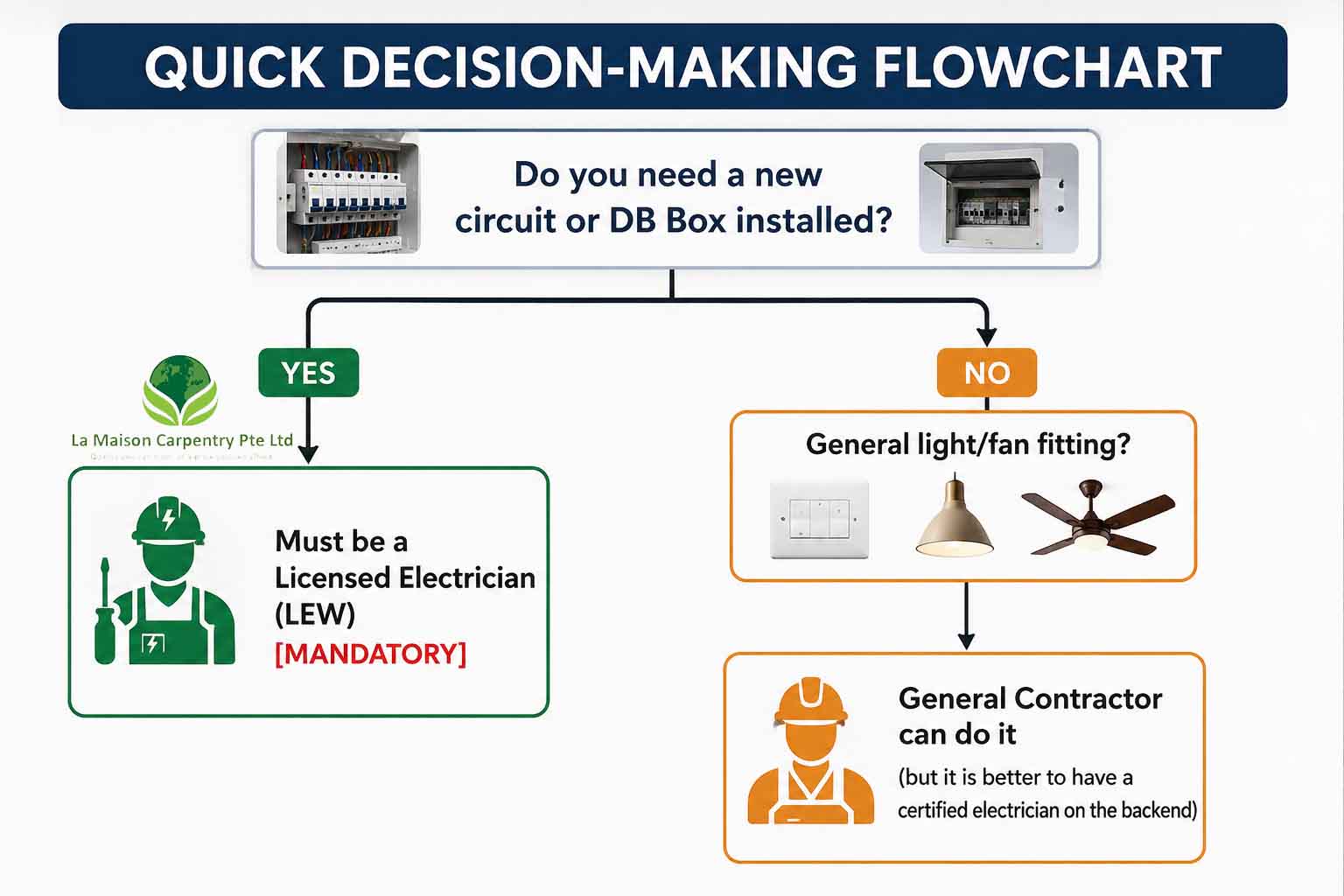
- If you need to do afull house rewiring, DB Box Replacement, or main electrical load change, you are legally required to hire aLicensed Electrical Worker (LEW)or licensed electrician.
- If it is a small job like changing a light bulb, setting up a ready-made plug-and-play gadget, or coordinating an entire interior project, it is possible to get the job done with a General Contractor.
What Is a Licensed Electrical Worker (LEW)?
In Singapore, professionals certified by the Energy Market Authority (EMA) are called Licensed Electrical Workers (LEWs). They are legally required to work in accordance with Singapore’s strict electrical safety standards.
EMA mainly issues three types of electrical licenses:
- Electrician’s Licence (L6):This is most commonly seen for residential work. They can design and install single-phase or three-phase loads up to 45 kVA (which is enough for HDB and most condos).
- Electrical Technician’s Licence (L7):They can work on medium-sized commercial and residential lines up to 500 kVA.
- Electrical Engineer’s Licence (L8):They are allowed to work in large commercial complexes, industries, or high-voltage grids.
Remember:A LEW not only does the work, but he or she also has the authority to sign the necessary legal compliance and testing certificates for theSingapore SP Group and HDB after the work is done.
What Does a General Contractor Actually Do During Renovation?
A general contractor is the manager of your entire renovation project. He coordinates multiple tasks such as carpentry, plastering, painting, and masonry (tiling).
Main role of the contractor:
- Maintain the timeline of the entire project.
- Explaining the work of various subcontractors.
- Maintaining the design and architectural layout.
Legal restrictions:Unless a general contractor is itself anEMA licensee, it cannot legally touch your home’s main distribution board (DB Box) or the wires of a new wiring line. They usually hire a third-party licensed electrician on the backend to do the work.
Licensed Electrician vs General Contractor Comparison Table
For your convenience, a detailed comparison based on more than 20 points is given below:
| Comparison Area | Licensed Electrician (LEW) | General Contractor |
|---|---|---|
| EMA Licence | Mandatory | Not required (unless they have a licensed electrical division) |
| Legal Scope of Work | All electrical installations, testing, maintenance, and repairs | General project coordination and cosmetic renovation work |
| Full Home Rewiring | Legally authorized and qualified | Not permitted without licensed electrical personnel |
| DB Box (Distribution Board) Upgrade | ✔ Can perform | ✘ Not permitted |
| HDB/Condo Permit Signing | ✔ Can sign and certify | ✘ Cannot sign |
| Safety Certificate Issuance | ✔ Authorized to issue | ✘ Not authorized |
| Circuit Breaker (MCB/RCCB) Testing | ✔ Can perform | ✘ Cannot perform |
| Installing New Lighting Points (New Wiring) | ✔ Can install | ✘ Cannot perform |
| Replacing Existing Sockets or Light Fixtures | ✔ Can perform | ✔ Can perform (for basic replacement work) |
| Interior Carpentry & Design | ✘ Not their primary role | ✔ Primary responsibility |
| Whole-Home Renovation Management | ✘ Not their role | ✔ Main responsibility |
| Plumbing & Masonry Coordination | ✘ Does not coordinate | ✔ Coordinates multiple trades |
| Electrical Fault Diagnosis (Short Circuits) | ✔ Highly skilled | ✘ Generally not qualified |
| Earthing System Inspection | ✔ Can inspect and test | ✘ Cannot perform |
| Compliance with Singapore Safety Standards (SS 638) | ✔ Fully compliant | Limited knowledge; no legal authority |
| Insurance Risk | Low risk when work is properly certified | Higher risk if regulated electrical work is carried out without a licensed professional |
| Warranty | Technical and electrical safety warranty | Renovation workmanship and finishing warranty |
| Typical Pricing Model | Fixed or job-based pricing according to technical scope | Lump-sum or project-based renovation pricing |
| Primary Service Focus | Residential electrical installation, repairs, and compliance | Overall renovation and project management |
| Emergency Electrical Faults | ✔ Fast troubleshooting and repairs | ✘ Usually no 24/7 emergency electrical support |
When Is a General Contractor Enough?
It’s not always necessary to call a freelancer or a separate LEW directly. In some cases, a general contractor will suffice:
When you are doing a major renovation project, such as creating a false ceiling in the living room, modifying kitchen cabinets, etc. During this time, the contractor can handle cosmetic electrical changes to your home (such as fitting lights or wiring).
But make sure that your contractor is working with a certified team at the backend. If you want a complete renovation with integrated electrical services that are trustworthy and legal, you can take the help of an experiencedLa Maison Carpentry Electrical Services, who maintain 100% compliance in both carpentry and technical safety.
Risks of Hiring the Wrong Professional
The consequences of having major electrical work done by an unlicensed mechanic or unskilled contractor can be serious:
- Insurance claim cancellation:If for some reason your flat catches fire due to a short circuit and an investigation shows that the work was done by a non-licensed person, no insurance company in Singapore will pay you even $1 in compensation.
- HDB Compliance Failure:After the renovation, HDB or Condo Management can conduct random inspections at any time. Failure to produce the correct certificate can result in a hefty fine and an order to demolish the entire setup.
- Voltage Drop and Tripping:Using the wrong size Miniature Circuit Breaker (MCB) orResidual Current Circuit Breaker can lead to frequent tripping and damage to valuable home appliances.
How to Verify an Electrician’s EMA Licence
Don’t just take anyone’s word for it, always check the following checklist before working in Singapore:
- Want to see the license card:A genuine LEW has a photo-based pocket card issued by EMA.
- Check the online portal:Go directly to [EMA’s official website or eligibility portal].
- Verify license number:Input their license number (e.g. El/XXXXX) and check if the status is ‘Active’ and if the expiration date has passed.
- See License Class:Confirm whether he is suitable to handle your required load (e.g. for L6 class residential).
Typical Cost Comparison: Cost vs Value
When budgeting for renovations, you should consider the long-term value rather than just the initial cost.
| Job Description | Average cost of a general contractor (SGD) | Average Cost of a Licensed Electrician (SGD) |
| HDB 4-Room Full Rewiring | $2,800 – $3,500 | $3,800 – $5,000 |
| DB Box Replacement | $400 – $600 (Risky) | $700 – $1,100 (Certified) |
| Single PowerPoint Add | $60 – $90 | $90 – $140 |
Why is it said that paying more saves money?
Licensed professionals use the right grade of copper wire, original circuit breakers, and perfect load calculations. This ensures that your line is free from major faults for the next 10 to 15 years, saving you the cost of repeated repairs.
Decision Guide: Who to hire in your situation?
Scenario 1:You have moved into a brand-new BTO flat and just want to install some extra sockets and downlights.
Decision: Your main renovation partner or general contractor can do this, provided they use a certified electrician as a subcontractor.
Scenario 2: You have bought a 30-year-old resale HDB flat and want to change the entire wiring.
Decision: Hire a Licensed Electrical Worker (LEW) blindly. It is illegal and dangerous to leave this to a general contractor.
Scenario 3: You need to lay new high-load lines for the oven and induction cooker during your kitchen renovation.
Decision:Let the contractor do the renovation layout, but ensure that a licensed electrician is present for the main wiring connections and circuit breaker setup.
Whether you need a licensed electrician for rewiring or a complete renovation solution,get in touch with La Maison Carpentry to discuss your requirements with our team.
FAQs about Licensed Electrician vs General Electrician
Can a general contractor sign an electrical certificate in Singapore?
No. In Singapore, only a Licensed Electrical Worker (LEW) approved by the Energy Market Authority (EMA) can sign a compliance certificate for any new or modified electrical installation.
If my contractor says they have their own electrician, what should I check?
You will want to look directly at the specific electrician’s EMA license number and a copy of the card. The license must always be registered in the name of an individual, not the contractor’s company.
What to do if the HDB inspection fails due to incorrect wiring?
You should immediately hire a certified LEW to re-test the entire system. Wherever defects or substandard cables have been used, re-wiring should be done according to Singapore government guidelines, and re-certification should be submitted.